1,000,000,001st
Rubik Cube
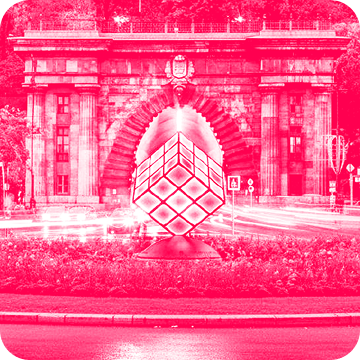
In the heart of Hungary and Budapest, at its symbolic center, we pay tribute to Hungarian talent and genius with this special giant Rubik Cube artwork installed in the middle of the square. The work is a reinterpretation of the original Rubik Cube: a handheld object that works without any external energy source and can be understood and used anywhere in the world, regardless of language, age, or cultural background. The Rubik Cube is a universal tool that can bridge cultural barriers while developing our intellectual abilities. It has been held by billions of people, represents a challenge across generations, and never becomes obsolete.
For the artist and the professionals involved in the casting process (Attila Rajcsok and Tamas Gilly), creating this public sculpture was both an honor and a serious creative challenge. The final work reflects the expectations of people in the 21st century and was born as a contemporary artwork. The cube's six colors are represented by six different lace patterns with personal meaning.
The sculpture is not only a memorial, but also an interactive experience: it allows anyone to try solving the giant Rubik Cube freely, either on-site or remotely, by controlling the sculpture's fields in real time through the project's web interface.
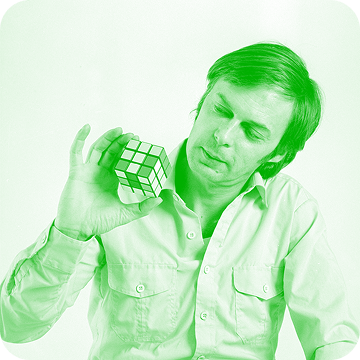
The world-famous logic puzzle was created by Hungarian architect and industrial designer Erno Rubik in 1974, originally as an educational tool to demonstrate spatial thinking. The invention quickly outgrew its original purpose: in the 1970s and 1980s it became a global phenomenon and one of the best-known and best-selling games of all time. The Rubik Cube is not only a puzzle, but a cultural icon appearing in art, design, scientific thinking, and pop culture alike.
The success of the cube goes beyond entertainment. It became a symbol of problem-solving, perseverance, and creative thinking, while also being regarded as a milestone in industrial history. It represents both engineering precision and the joy of playful discovery, and it continues to inspire artists, researchers, and educators worldwide. The Rubik Cube is a lasting Hungarian intellectual achievement that has left a permanent mark on global culture.

Samuel Havadtoy is a British-born visual artist of Hungarian origin whose life and art are defined by dual identity. In the New York art scene of the 1970s and 1980s, he worked for two decades with defining figures of pop art and contemporary culture, while his Eastern European roots became deeply embedded in his visual thinking. In his work, bold and playful American pop art and the anxiety-filled experience of Eastern European existence appear together: repression, pain, and the longing for freedom are hidden behind delicately embroidered patterns.
Havadtoy's oeuvre forms a bridge between cultures, continents, and ways of thinking. Through his galleries, collaborations, and public artworks, he repeatedly asks how personal and collective historical experiences can be cast into contemporary forms that everyone can understand. The Rubik Cube public sculpture is a natural continuation of this approach: a reinterpretation of an iconic Hungarian invention that is at once a tribute, an artistic statement, and a community experience.

Total combinations
43 quintillion
God's Number
20 moves
World record
3.13 seconds
Cubes sold
450M+
The world-famous logic puzzle was created by Hungarian architect and industrial designer Erno Rubik in 1974, originally as an educational tool to demonstrate spatial thinking. The invention quickly outgrew its original purpose: in the 1970s and 1980s it became a global phenomenon and one of the best-known and best-selling games of all time. The Rubik Cube is not only a puzzle, but a cultural icon appearing in art, design, scientific thinking, and pop culture alike.
The success of the cube goes beyond entertainment. It became a symbol of problem-solving, perseverance, and creative thinking, while also being regarded as a milestone in industrial history. It represents both engineering precision and the joy of playful discovery, and it continues to inspire artists, researchers, and educators worldwide. The Rubik Cube is a lasting Hungarian intellectual achievement that has left a permanent mark on global culture.
+36 455 67777 info@xxxx.hu

Loading player data...